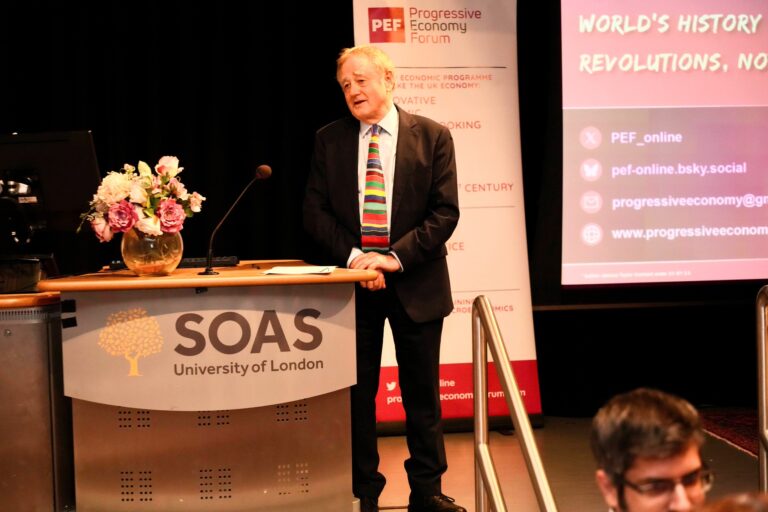

by Patrick Allen, Founder and Chair of the Progressive Economy Forum.
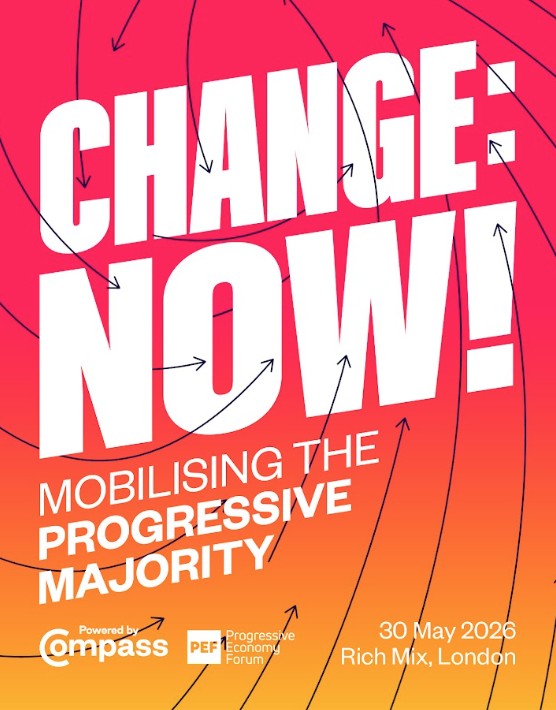
Welcome to the PEF–Compass Conference!
This is our fourth annual conference and our first in partnership with Compass, which makes it our biggest and most ambitious conference yet.
I founded the Progressive Economy Forum in 2018 out of frustration at the damage caused by austerity and the acceptance by many that there was no alternative, and that cuts were both necessary and responsible to reduce debt. Nearly everyone in the media and large parts of the electorate bought into the idea that reducing the deficit was the number one priority.
George Osborne and David Cameron at the head of the coalition government peddled the notion that the 2008 global financial crisis was the result of excessive public spending in the UK!
That story was wrong, the economics wrong, and its consequences have been devastating.
Austerity has wrecked our public service es and our public health . This and and the long-term damage done by neoliberalism since 1979 explain why we are in so much trouble today. Austerity helped fuel right wing populism, Brexit and the politics of Farage.
I am passionate about macroeconomics: the toolkit to manage the economy. Get budgets, taxation, investment, and public spending right, and you can build a society that is more secure, more prosperous, resilient, and sustainable.
I believed politicians and economists were not doing enough to challenge the damage being done to public services and the flawed economics behind it. So, I created PEF to build credible, progressive alternative economic policy
Over the past eight years, PEF has brought together economists, academics, politicians, campaigners, trade unionists to challenge the failed neoliberal consensus and develop better answers. We helped shift the argument on austerity by writing papers, blogs and delivering lectures and conferences
We aim to be a bridge between politicians and economists. We worked well with John McDonnell when he was Shadow Chancellor. Our access to the current team has been more limited, but now there is to be a change of leadership, the door may be wide open. This is, therefore, a great opportunity.
We are engaged in the battle of ideas: how to explain what has gone wrong in Britain, and what a serious progressive alternative looks like.
And to get these ideas implemented, we need to create a better, more representative democracy so that the progressive majority has a voice.
What is striking is that the government still lacks a convincing plan and narrative. It cannot explain what has gone wrong, why so many people feel poorer , angry and less secure, or what long-term change is needed.
Compare that with the post-war Attlee government of 1945. They had prepared for government, determined to end the poverty and mass unemployment of the 1930s.
Keynes, Beveridge, Morrison, Attlee— they had the ideas. They had the vision and the plan, and transformed the country by building the welfare state and the NHS, even while paying back wartime debt.
Well at PEF we have an analysis and a plan .We believe the roots of our crisis are clear. Decades of privatisation, deregulation, financialisation, de-industrialisation, weak investment, attacks on trade unions, and the growth of a rentier economy have left Britain more unhappy, more unequal, more insecure , less productive, and less resilient. We have stagnant wages, underfunded public services, insecure housing, declining public health, and deep frustration.
If we do not respond with workable and realistic policy to meet this crisis, the far-right parties will be only too ready with simplistic and dangerous policies which could destroy our democracy and the country we know.
So this is a crucial moment in politics. Our task is to set out a practical progressive programme: reversing the legacy of austerity and privatisation , reducing poverty and inequality, investing in young people and the early years , rebuilding public services, raising investment and productivity, and making the case for a balanced and informed approach to immigration and Britain’s relationship with Europe.
And that programme must also confront the climate crisis—not as a burden, but as an opportunity to create jobs, renew infrastructure and build a cleaner, more secure economy.
Today’s conference is about these questions. You will hear ideas drawn from the UK and beyond like the nordic countries— Manchesterism, local economic renewal, tackling the rentier economy, wealth inequality, and the social conditions that damage health and wellbeing.
PEF today presents four new policy papers covering:
- The economics of immigration, correcting some myths
- Brexit—how we move closer to the EU, and perhaps rejoin
- Progressive fiscal and monetary policy, which is sustainable, keeping the bond markets onside
- Tackling wealth inequality – building an economy that works for society
We must together present a compelling economic offer coupled with the democratic renewal agenda. We must create a coalition which can turn these ideas into political power.
So please join the sessions, challenge the arguments, and help us build the ideas that progressive politics now urgently requires.
Going forwards, PEF will be expanding its activities, holding events and lectures, recruiting a full time secretariat and director and commissioning and publishing papers and blogs at regular intervals . So do keep in touch with us by joining our mailing list
Thank you.