
We set out below a selection of reports on issues where PEF has been influential in changing policy or the debate
The Case for a National Investment Bank
A National Investment Bank has a vital part to play in raising finance for projects of national and strategic importance. These projects may be costly and long term investments which would struggle to attract finance in the private market.
However, such projects can be financed at low cost by a national investment bank which will attract lenders at the lowest rates due to the security offered by the state akin to government stock
Seed corn funds can be invested in the bank by the government and then further funds attracted by gearing up with the issue of specific bonds by the bank.
The role and success of such banks has been proven in many countries . The EU has an EU wide national investment bank , The European Investment Bank , which provided substantial funds for UK projects when we were members of the EU.
PEF worked with John McDonnell in 2018 and 2019 when he was shadow chancellor of the exchequer to promote the concept for a future labour government .
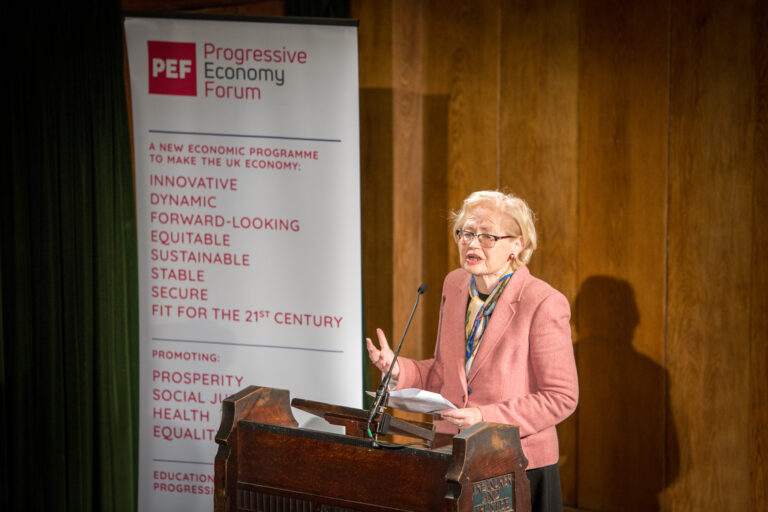
Stephany Griffth-Jones , an eminent macroeconomist and member of PEF council had written a seminal book on NIBs. She agreed to give a keynote talk at a public meeting and lecture promoted by PEF.
The meeting took place at the Conway Hall Red Lion Square , London on 7th February 2019. Stephany made the case for a National Investment Bank. John McDonnell attended and made a supportive speech in reply . Also speaking were Josh Ryan-Collins of UCL and PEF coordinator , John Weeks. The meeting was chaired by Patrick Allen
Stephany’s address to the meeting is here
This meeting was followed by by a seminar/workshop at HJA on 25th July 2019 entitled :
Lessons from European National Investment Banks
The event consisted of a series of presentations on European National and Multilateral Development Banks and on the Welsh Development Bank. This was followed by a presentation on a potential UK National Investment Bank from Professor Stephany Griffith Jones and Peter Rice, Managing Director of Clearpoint. Then by a presentation from Dr Josh Ryan-Collins on ‘A New Public Banking Ecosystem’.
Matthias Kollatz, former Vice President of the European Investment Bank (EIB) spoke on the experience of Germany’s development bank KfW which has played a major role in funding the country’s infrastructure and onshore wind. Isabelle Bébéar, Head of International Affairs and Management Programs at Bpifrance, presented on the experience of Bpifrance which serves both as a National Investment Bank and a Sovereign Wealth Fund.
This was followed by a presentation from Laurent Zylberberg, Senior Executive Vice-President for International and Public Affairs at Caisse des Dépôts, a public sector bank which has been operating since 1816. Markus Berndt, Head of Industrial Strategy at the European Investment Bank, presented on the EIB – the largest multilateral financial institution in the world. Rhian Elston, Investment Director at the Development Bank of Wales, presented on the role of the Development Bank which has been operating since 2001.
John McDonnell , shadow chancellor , attended the workshop throughout.
Basic Income Pilot
On 7th May 2019 PEF launched Guy Standing’s paper on a Pilot for Basic Income at the Royal Society of Arts, London. Speakers included Guy Standing , Anthony Painter , Patrick Allen, John McDonnell MP, Ed Miliband MP, Caroline Abrahams, Caroline Greenwood MP.
The paper was produced and printed by PEF
The event was attended by 150 people with a lively queue and answer session. During the discussion shadow chancellor John McDonnell confirmed that if elected Labour would carry out a pilot of universal basic income.
The Four day Week
on 12th September 2019 PEF launched a report by Robert Skidelsky at HJA on How to Achieve Shorter Working Hours.
In this report, Lord Skidelsky outlined why the trend of falling working hours has effectively stalled since the 1980s and how shorter working hours can be accomplished going forwards.
Joining Lord Skidelsky to comment on this report were Shadow Chancellor of the Exchequer John McDonnell, Patrick Allen, founder and Chair of PEF, Rachel Kay, researcher for Lord Skidelsky’s inquiry into working time, Miatta Fahnbulleh, Chief Executive of the New Economics Foundation and Kevin Rowan, Head of Organising, Services and Learning at the TUC.
Student Loans– Defending free tuition
In 2018, Danny Dorling and Michael Davis wrote a PEF paper entitled Jubilee 2022 , The writing off of student debt. It began as follows.
Labour is committed to ending tuition fees from the moment it is elected. This commitment to educational justice and quality is laudable, and will be a step towards ensuring our universities act as institutions for the public good, not profit-maximisers.
Since that paper, the situation has become much worse and politically toxic. The tide now seems to be turning and a political consensus is emerging that the current student debt scheme is untenable and must be scrapped.
PEF led the way with these arguments and proposed credible solutions.
The Dangerous Fiction of the Fiscal Black Hole !
After the disastrous “mini-Budget” in September 2022 which saw a sudden spike in government borrowing costs and a falling value of the pound, a new Prime Minister and Chancellor started insisting that a “fiscal hole” in the government finances now had to be filled by cutting spending.
Timely work by Rob Calvert Jump and Jo Michell exposed the “dangerous fiction” of the claims made by the government and others of a “fiscal black hole”, with the size of the supposed hole completely dependent on uncertain forecasts and the government’s own rules. You can read their report here.
PEF’s work attracted coverage on the BBC, including the Today programme; the Times, the Daily Mail, the Telegraph and across the broadcast and online media, helping set the domestic economic discussion in the run-up to a crucial Autumn Statement . Questions were put to Jeremy Hunt about the supposed “fiscal hole” and by the time of the Autumn Statement, the rhetoric was dropped entirely. Opposition to austerity is central to PEF’s aims and challenging the poor framing used to support arguments for it is crucial in improving the quality of public economic debate in Britain.